
Disease & Die-Off — Middle Tennessee
Dead Deer & EHD in Middle Tennessee
Epizootic Hemorrhagic Disease Kills Deer Fast — What Property Owners Need to Know
Every late summer and early fall, Middle Tennessee experiences EHD outbreaks that kill deer in large numbers. Deer die quickly — often near water — and property owners find carcasses on their land with no obvious cause. If you've found a dead deer in August, September, or October, EHD is the most likely explanation. Here's what it is, why it matters, and what to do.
(615) 613-5992 — Call Now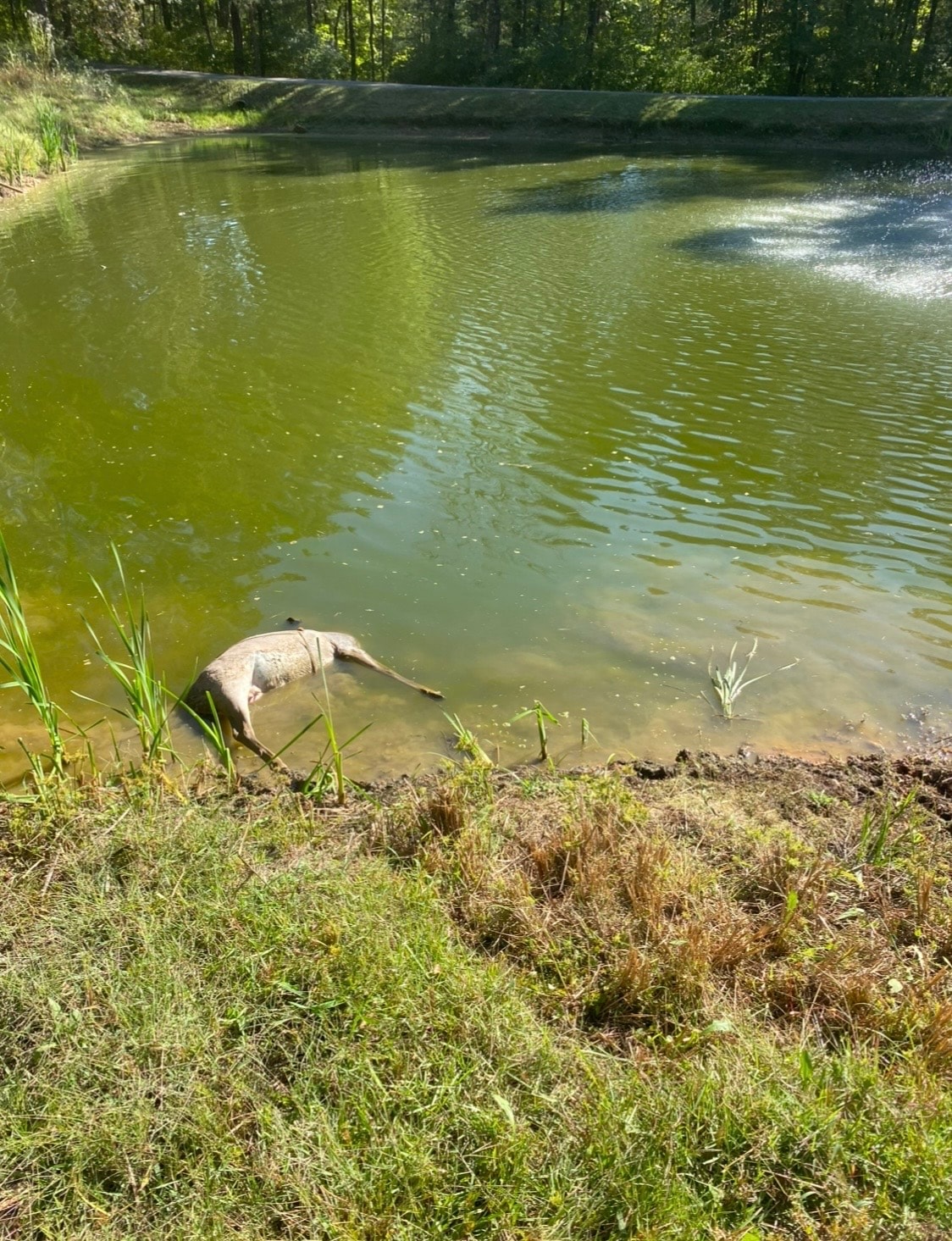
What Is EHD?
Epizootic Hemorrhagic Disease (EHD) is a viral hemorrhagic disease of white-tailed deer transmitted by biting midges (Culicoides species) — tiny insects sometimes called no-see-ums or gnats. The virus causes internal hemorrhaging, high fever, and rapid death. Bluetongue virus (BTV) is a closely related disease transmitted by the same midges and produces nearly identical symptoms and mortality. Both are often grouped together as 'hemorrhagic disease' and are the leading cause of deer die-offs in Tennessee.
Transmission
Biting midges (Culicoides species) — not deer-to-deer contact, not ticks
Season
Late July through first hard frost — peak in August and September in Middle Tennessee
Mortality
High in naive populations; deer that survive develop immunity
Human risk
None — EHD and bluetongue do not infect humans
Livestock risk
Bluetongue can infect cattle and sheep; EHD is deer-specific
Reporting
TWRA tracks EHD outbreaks statewide — reports help monitor spread
Why Middle Tennessee Gets Hit Hard
High deer density
Middle Tennessee's mix of agricultural land, suburban edges, and wooded corridors supports one of the highest white-tailed deer densities in the state. More deer means more EHD mortality when outbreaks occur.
Late summer drought concentrates deer at water
EHD outbreaks peak during late summer droughts. Deer congregate at shrinking water sources — creeks, ponds, stock tanks — where midge populations are highest. This is why EHD deer are so often found dead near water.
Warm, wet summers favor midge populations
Culicoides midges breed in wet mud at the edges of water bodies. Middle Tennessee's warm, humid summers create ideal midge habitat. Years with wet springs followed by late summer drought are historically the worst for EHD.
Naive deer populations in suburban areas
Suburban deer populations that have not been exposed to EHD in previous years have no immunity. When EHD reaches a naive population, mortality can be very high — sometimes 50% or more of the local herd.
Outbreak years are unpredictable
EHD does not occur every year at the same intensity. Some years see widespread die-offs across multiple counties; other years see minimal mortality. TWRA tracks outbreak reports, but property owners are often the first to notice.
EHD Season in Middle Tennessee
July
Low to moderateMidge populations building; early cases possible in drought years
August
HighPeak midge activity; drought concentrates deer at water; most EHD deaths occur
September
HighContinued outbreak activity; late summer drought extends midge season
October
ModerateActivity declines as temperatures drop; ends with first hard frost
November onward
NoneFrost kills midges; EHD transmission stops until following summer
How to Recognize an EHD Death
Found near water
EHD causes high fever. Affected deer seek water to cool down and often die at the water's edge, in shallow water, or in creek beds. Finding a deer dead in or near water in late summer is a strong indicator of EHD.
Late summer timing
EHD deaths cluster in August, September, and early October. A deer found dead in this window with no obvious injury is very likely an EHD mortality.
No obvious injury or vehicle strike
EHD deer show no external trauma. The carcass appears intact. Internal hemorrhaging is the cause of death but is not visible externally.
Swollen face, tongue, or hooves
In deer that survive long enough to show clinical signs, swelling of the head, tongue (hence 'bluetongue'), and coronary bands of the hooves is characteristic. Many deer die before these signs are visible.
Multiple deer in the same area
EHD outbreaks often produce multiple deaths in a localized area over a period of days to weeks. Finding more than one dead deer near the same water source is a strong indicator of an active outbreak.
What to Do If You Find an EHD Deer
Do not handle the carcass without protection
EHD does not infect humans, but a decomposing deer carcass carries the same bacterial, parasite, and fluid hazards as any other carcass. Do not handle it without gloves and appropriate PPE.
Keep pets away
Dogs that investigate or eat from an EHD carcass are not at risk for EHD, but are at risk for the same parasite and bacterial hazards as any deer carcass — ticks, tapeworms, and decomposition bacteria. Keep dogs away from the site.
Report to TWRA if multiple deer are affected
Tennessee Wildlife Resources Agency tracks EHD outbreaks to monitor disease spread and herd impact. If you find multiple dead deer or suspect an active outbreak, report to TWRA at 1-800-332-0900. Single carcasses do not require reporting but can be noted.
Call for professional removal
EHD carcasses decompose the same as any deer carcass and carry the same removal and disposal requirements under Tennessee law. TWRA-permitted removal is required for legal disposal. Same-day service is available across Middle Tennessee.
EHD Carcass Removal — What's Different
Often found near water
EHD deer frequently die at creek edges, pond margins, and in shallow water. Water-adjacent or in-water extraction requires the same containment and equipment as any waterway removal — standard land-based removal methods don't apply.
Outbreak years mean multiple carcasses
In a significant EHD year, a single property may have multiple deer die over a period of days to weeks. We can assess the full site and handle multiple carcasses in a single visit.
Same legal disposal requirements
EHD does not change the legal requirements for carcass disposal in Tennessee. TWRA-permitted disposal is required regardless of cause of death. We handle all disposal in compliance with state regulations.
Site cleanup matters near water
An EHD carcass near a water source requires the same site cleanup as any waterway-adjacent removal — decomposition fluids and tissue contaminate soil and can reach the water. Enzyme treatment of the site is included in our service.
Common Questions
Can I get EHD from a dead deer?
No. EHD and bluetongue virus do not infect humans. You cannot contract EHD by touching, handling, or being near a deer that died from the disease. The carcass still carries the same bacterial and parasite hazards as any decomposing deer, so standard precautions apply.
Can my dog get EHD from sniffing or eating a dead deer?
No — EHD does not infect dogs. However, a dog that eats from an EHD carcass is exposed to the same risks as any carcass: ticks, tapeworm eggs, decomposition bacteria, and protozoan oocysts. Keep dogs away from the site and consult your veterinarian if your dog has had significant carcass contact.
Is the deer safe to eat if it died from EHD?
TWRA and USDA advise against consuming deer that died from EHD. The disease causes internal hemorrhaging and rapid decomposition, and the carcass condition is typically unsuitable for consumption. Additionally, salvaging a deer that died from disease rather than a hunter's harvest raises legal questions under Tennessee salvage permit rules.
Will EHD wipe out the deer herd on my property?
EHD outbreaks can cause significant local mortality, but rarely eliminate a deer population entirely. Deer that survive an outbreak develop immunity. Herd recovery typically occurs within 2–3 years in areas with good habitat. TWRA monitors herd impacts and adjusts harvest regulations in heavily affected counties.
I found three dead deer near my pond in September. Is this EHD?
Multiple deer found dead near water in August–October with no obvious injury is the classic EHD presentation. We recommend reporting to TWRA (1-800-332-0900) to contribute to outbreak tracking, and calling us for prompt removal. Multiple carcasses near a water source accelerate contamination — don't wait.
Does EHD come back every year?
EHD outbreaks are cyclical but not annual. Middle Tennessee typically sees significant outbreaks every 3–5 years, with minor activity in intervening years. Drought years are most likely to produce large outbreaks. There is no way to predict outbreak severity in advance.
Found a Dead Deer This Summer? Call Now.
EHD kills fast and leaves carcasses near water. Same-day removal across Middle Tennessee — TWRA-permitted, fully insured.
(615) 613-5992 — Call Now